
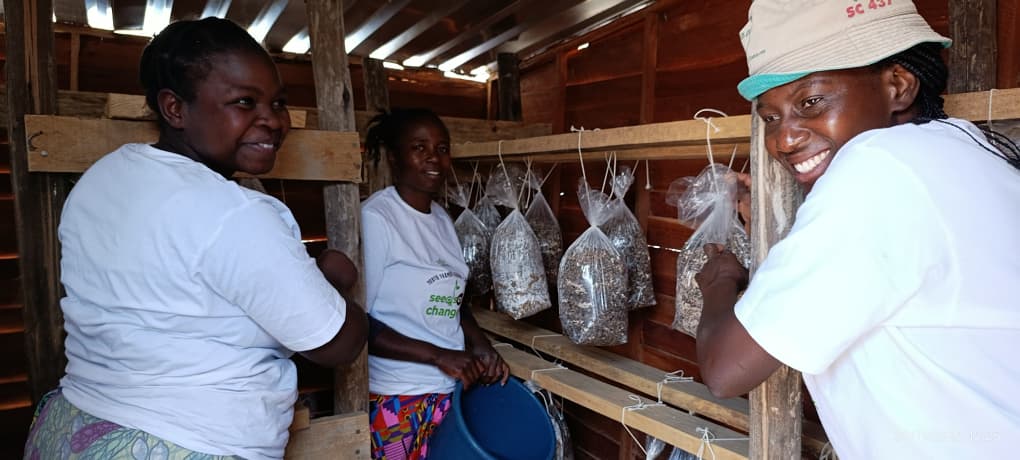
Supported by the Agroecology Fund, Seeds of Change: Youth Mobilizing for Agroecology Transition and Sustainable Food Systems is a multi-country initiative focused on advancing agroecology as a pathway to resilient, inclusive, and sustainable food systems. The project seeks to address systemic barriers that limit the meaningful participation of youth and women smallholders in food systems transformation, while strengthening food sovereignty, biodiversity, and climate justice.
Across Africa and much of the Global South, food systems are increasingly shaped by industrialized, capital-intensive, and vertically integrated models of production, processing, and distribution. These trends marginalize smallholder farmers, erode traditional knowledge, degrade ecosystems, and reinforce inequality. At the same time, youth and women – who are most affected by climate change, poverty, and social exclusion – continue to have the least access to land, finance, training, and decision-making spaces, despite global and regional commitments such as the 2030 Agenda for Sustainable Development and the African Union’s Agenda 2063.
Evidence from practice and research shows that smallholder farmers, particularly youth and women, play a critical role in sustaining local food systems and ecosystems. Yet their livelihoods are increasingly threatened by climate-induced shocks, rising input costs, and exclusionary policies. Without deliberate efforts to address these structural challenges, food systems will remain unjust, extractive, and vulnerable to climate and economic crises.
Seeds of Change responds to these realities by empowering youth and women smallholders as agents of transformation. Through hands-on agroecology training, inclusive policy engagement, and grassroots movement-building, the project aims to strengthen local capacity, reduce dependence on chemical inputs, and support community-led innovation. The initiative centers youth and women not only as implementers of solutions, but as co-creators of knowledge, policy, and practice needed to drive a just transition in food systems.
In the short term, the project focuses on enhancing skills and building collaboration among diverse actors through meaningful dialogue that highlights agroecology’s contribution to food sovereignty, biodiversity conservation, and climate justice. Over the long term, it seeks to strengthen a local and global movement of youth and women smallholders, promote the adoption of agroecology in policy and practice, and reshape narratives around climate and biodiversity crises to recognize smallholders as an integral part of the solution.
The multi-country project is currently implemented in Kenya, Zambia, Zimbabwe, and Kenya.
Project Objectives
The project is guided by the following objectives:
- Enhance Capacity and Skills
To strengthen the capacity of youth farmers, women smallholders, and local organizations through hands-on agroecology training, equipping them with the knowledge and skills to steward food sovereignty and environmental sustainability. - Demonstrate Agroecology in Practice
To showcase the viability and replicability of agroecology as a sustainable alternative to conventional food systems, while improving resilience and climate adaptation among smallholder farming communities. - Reduce Environmental and Economic Costs
To reduce chemical externalities and production costs in line with agroecology principles, particularly input reduction and ecological regeneration. - Create Green Livelihoods
To generate green jobs and contribute to an inclusive green economy for youth and women farmers. - Strengthen Policy Engagement
To provide inclusive consultation platforms that ensure farmers’ perspectives inform food systems decision-making and policy processes. - Foster Collaboration and Learning
To facilitate knowledge sharing, networking, and collaboration among African youth and food systems stakeholders. - Raise Awareness and Shift Narratives
To increase awareness of the critical role of youth and women farmers in achieving sustainable agriculture, food sovereignty, and the 2030 Sustainable Development Goals.
Through Seeds of Change, we aim to ensure that food systems transformation is driven from the ground up—rooted in community knowledge, youth leadership, and the lived experiences of women and smallholder farmers.