
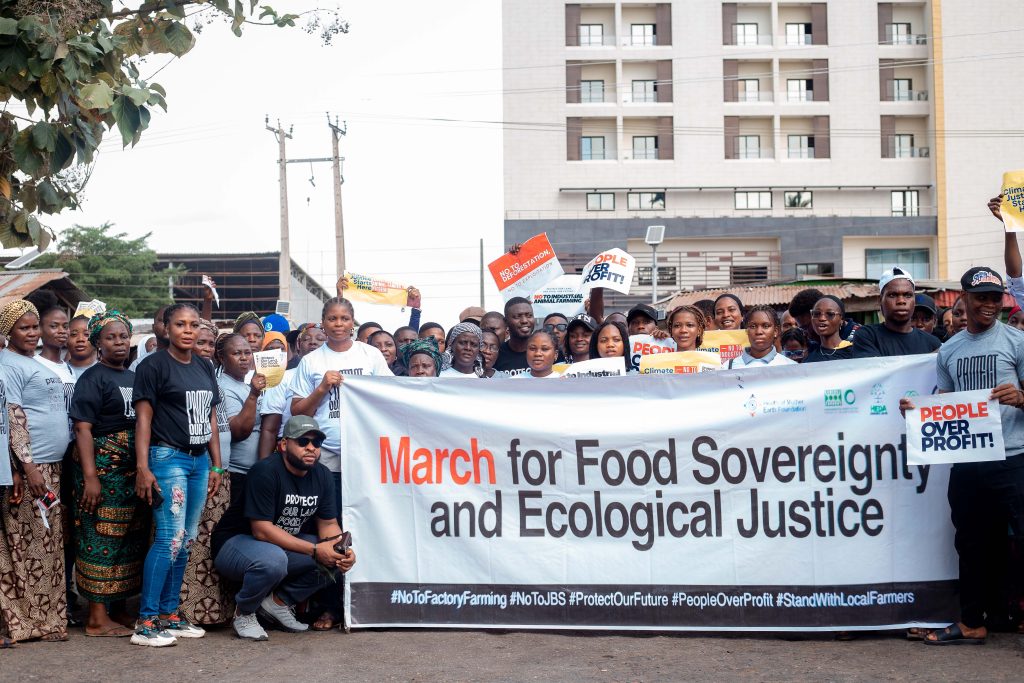
Industrial animal farming – often referred to as factory farming – is rapidly emerging as a defining issue in Nigeria’s agricultural and food production landscape. Its expansion carries profound consequences for public health, environmental sustainability, animal welfare, labor rights, community livelihoods, and food sovereignty. The proposed entry of JBS into Nigeria heightens the urgency of critically examining the long-term impacts of large-scale, industrialized farming models on people and ecosystems.
In December 2024, the Nigerian government signed a Memorandum of Understanding with JBS S.A., the world’s largest meat processing corporation, to establish industrial animal farming facilities valued at $2.5 billion across several states in Nigeria. While the investment has been promoted as a pathway to job creation and improved food security, it has sparked serious concerns among civil society organizations, farmers, pastoralists, and community representatives regarding its social, environmental, economic, and human rights implications.
This project, led by YARN, in partnership with the Health of Mother Earth Foundation, Friends of the Earth, HEDA Resource Centre, and World Animal Protection aims to elevate public and policy awareness of the risks associated with JBS’s business model by spotlighting evidence of its socio-ecological and unethical practices globally, and drawing parallels with local extractive experiences in Nigeria, such as the long-standing impacts of oil pollution in the Niger Delta. Through research, workshops, policy engagement, media advocacy, and community mobilization, the project centers the voices of smallholder farmers, pastoralists, indigenous peoples, and frontline communities, who are often excluded from decision-making yet most vulnerable to displacement and environmental harm.
Using JBS as a case study, the project brings together stakeholders from government, academia, civil society, farming communities, the health sector, and the media to:
- Examine the impacts of industrial animal farming on Nigeria’s food systems
- Document community experiences and concerns related to existing industrial farms
- Develop evidence-based advocacy resources for policymakers
- Strengthen civil society and media capacity to engage on factory farming issues
- Advance policy reforms that promote resilient, just, and sustainable food systems
As Nigeria stands at a crossroads in shaping the future of its food and agricultural systems, this project calls for transparent, inclusive, and people-centered decision-making. We invite policymakers, civil society, farmers, journalists, researchers, and concerned citizens to engage with this process and work collectively toward food systems that protect people, animals, and the planet.